May 2026
Further thoughts on WRITING - MEDITATION - MENTAL HEALTH - CRICKET - LIFE
Jim
3/29/20265 min read

WRITING - MEDITATION - MENTAL HEALTH - CRICKET - LIFE
A few words about some of my headline interests as listed on the home page:
I’ve felt at home with books (and dogs) from a very early age. When I glance back at my childhood, I usually see myself hanging out with the family cocker spaniel, or reading in a favourite armchair during the long summer holidays. English and History were my favourite subjects at school. From there I went on to read English at Cambridge, after which I took a Master’s degree in Modern Literature (The Novel) at the University of East Anglia (in the era of Malcolm Bradbury and Kazuo Ishiguro). One of the great gifts from Cambridge was the discovery (in 1974) of Zen, courtesy of an inspired and inspiring director of studies. The doors of perception were flung open and literature and life never looked the same again.
As the doors inched shut over the years (they tend to for all of us if we don’t have some consciously applied way of keeping them open) I found myself searching – on occasions in extreme desperation – for people who could help me prise or blow those doors open and allow me to feel human (enough) again. There have been many blessed guides along the way, helping me to make my own path – as we all have to – through the pathless land of recovery and discovery.
Some of these guides have been psychotherapists, in whose company I learned a great deal about myself, about everyone else, and about how we can all get along together – and what gets in the way of us doing just that.
It was good to be doing this painful work towards self-knowledge. It helped me make sense of the years – decades, in fact – when my working life was focused on the provision of the right kind of support services for people in extreme states of mental and emotional distress.
(And – an important aside – what are the right kind of support services? They’re easy to describe: human-shaped, receptive, compassionate, collaborative, respectful, creative, hopeful. Not so easy to deliver, it would seem - as our current state of mental health provision starkly demonstrates. After all these years of research, innovation and campaigning, still so much to do.)
Work and life were showing me that many people were suffering – sometimes it seemed as if it was nearly everyone. But of course, the key learning was that this wasn’t just about other people. I had to include myself, to look into the nature of my own suffering and discover the ways through, to a different kind of life – for me, and so for everyone else.
As my hands-on work in the mental health field shifted to writing and to the production of broadcast materials (still focusing on creative self-help and wellbeing initiatives) I found myself drawn ever more to the practice of meditation. I had first been taught to meditate in 1980 by a volunteer in a West London homelessness hostel that I was helping to run. The doors were definitely blown open again, but this time I actually had to do something, not just read about it and imagine that I was Jack Kerouac, Allen Ginsberg, Henry David Thoreau, Walt Whitman…
This kick-started my deeper engagement with all things Buddhist: lots of reading, intermittent retreats and a trip to India and Nepal. But it wasn’t until many years later, when I discovered a worldwide community of meditators (‘a monastery without walls’) rooted in the ancient Christian contemplative tradition, that I developed a regular practice that took me back to ground zero, to the ground of my (our) being, twice a day, every day.
I began to understand meditation, not as one of many ‘lifestyle choices’, not as a way of increasing my performance or effectiveness within whatever field I was operating in, not even as a route to enhancing my happiness or wellbeing (though that can be a welcome side-effect). All of these are understandable and worthwhile aspirations. But there was something that John Main – the founder of the ‘monastery without walls’ – had once said that felt to me like a profound game-changer, and still does:
We don’t meditate in order to relax; we relax in order to meditate.
It reads like a simple and neat little aphorism, but - if fully attended to – it operates as a profound challenge to everything we habitually assume about our lives. Behind that beguilingly innocent little statement lies everything that all of the great wisdom traditions – Zen, the Tao, Sufism, the Vedas, the Bhagavad Gita, Christian contemplative prayer – hold to be hiding in plain sight: that we are at our most truthful, our most real, when we are sitting in silence, laying aside thoughts, stepping away from the limitations of language, ideas, fixations, regret, planning… This is the time when we are learning to be simple again.
Zen asks us what was our original face before we were born. The Sufi poet invites us to fall recklessly, trustingly, in love with The Beloved. The Benedictine contemplative encourages us to fully accept the gift of our life: to sit in the simple experience of the truth.
It’s these teachers that have led me to understand the practice of meditation as our way towards becoming unconditioned. Repeatedly setting aside the beliefs, the scripts, the fears, the obsessions – the entire cluster of limitations that we have learned to call ‘myself’ – this is the way to start breaking free from the dead weight of the past and from the desert of craving and aversion that the world will increasingly become until we start to want to wake up.
Robert Kennedy (not that one – nor his nephew, currently, and puzzlingly, in charge of the health of all US citizens), this Robert Kennedy is a Jesuit priest, a Jungian psychotherapist and a roshi (a Zen honorific meaning ‘great teacher’). He’s 90 years old now, and I’ve learned a great deal from him. He once said that Zen is valuable because it stops us being ‘silly or sentimental’. Indeed it does, and it challenges all our assumptions by trying to drive us – lovingly, frustratingly, entertainingly – out of our tiny, limited minds and into the direct experience of the present moment and everything arising within it. Zen’s intention is to interrupt our tendency to attach to things, to people, to beliefs, and to challenge the way that we forge an identity – a ‘self’– out of that attachment. We seem to have this almost implacable desire to fix the world, to take possession of bits of it, to stay in control. Zen lets us know that such a desire is laughably absurd and is the root of all our suffering. So it laughs, and encourages us to laugh as well, and to get over our terrible seriousness. In other words, to get over our selves.
Robert Kennedy Roshi introduced me to the work of Jane Hirshfield, a brilliant American poet who has offered this radiantly simple insight into Zen and into life:
Zen pretty much comes down to three things - everything changes; everything is connected; pay attention.
Zen also discourages us from getting attached to Zen itself, or to the notion (which is, like so much else, just a notion) of ‘gaining enlightenment’. I think there’s something of this recognition in the response of John Main when asked how long ‘all this’ (?? presumably, being ‘saved’, arriving in the kingdom, not being plagued by thoughts of lunch when meditating??) – how long ‘all this’ would take. John Main’s response is as priceless as any Zen koan:
It takes as long as it takes to realise that it takes no time at all.
Where does that leave us? With nowhere else to go but into the present moment, to look into it and see what is there. What will we find? I have no idea; that’s why it’s worth doing. And to keep on doing it, in what we seem to have no choice but to call ‘the next moment’, and the next one after that. Oh, and don’t forget the depth-charge of a contribution to the ‘how long will it take?’ debate, from Dogen (1200-1253), founder of the Soto Zen School):
Do not think you will necessarily be aware of your own enlightenment.
So, who knows?
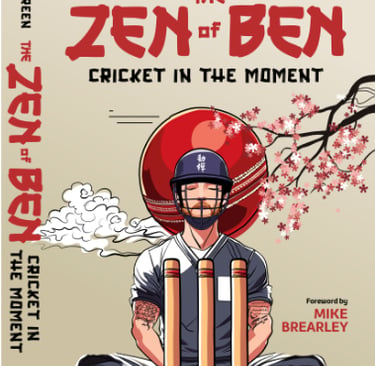
Oh, and I’ve just realised that I haven’t mentioned cricket at all. Sorry about that – it looks like you’re just going to have to read the book.